Our Events Calendar
Reply
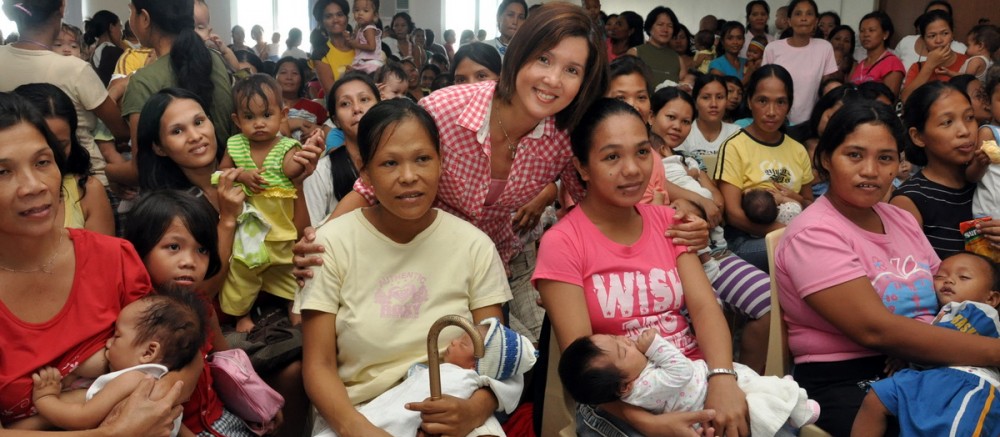
by Pia S. Cayetano
My Breastfeeding Story
Did I know that I would be up at 2am, 3am and 4am every day nursing my baby in pain, wondering where in the world was the milk coming from as she has been sucking almost continuously for 3 hours?
Similarly, no one told me, it would be one of the best decisions I ever made.
This is not just my breastfeeding story, this is the story of the formative months of the lives of each of my children, Maxine, Nadine and Gabriel.
Maxie

My first memory of doing anything that had to do with breastfeeding, is shopping in the US with my cousin Mashi who nonchalantly picks up an electric breast pump and tosses it in our cart. I said “What’s that?” and she just said, “You’ll need that.” Next thing I know we are buying a nursing bra, with a size C cup! She promised me that my breast would get that big. Hmm, that would be interesting.
Fast forward to my last few months of pregnancy. I read all the chapters of my pregnancy and baby care books and felt prepared to breastfeed my baby. I had actually made the decision to breastfeed soon after becoming pregnant. I felt that with my working hours, I would not be spending as much time during weekdays at home as I would want to, so breastfeeding would be a bonding activity between me and my baby. And it would be something my baby and I could share –something, her yaya, her grandmother or anyone else could not do for her. I wanted this to be our special time together.
So here I was, thinking I was all prepared. I just had to give birth and I would embark on the noble journey called motherhood.
Breastfeeding Journey
My 6 lb, 2 oz baby girl was born just before midnight on January 4, 1995 after 22 hours of labor. She screamed loud enough for my mom to hear her outside the delivery room.
The first 2 days were non-eventful. I managed to get enough sleep despite the discomfort of the episiotomy.[1] I knew my baby, who at that time (first 2 days) still had no name, was getting the colostrum[2] she needed. She was a fairly easy baby, not so ravenously hungry when she sucked.
So, here I was thinking, “This isn’t too bad, I’m doing a pretty good job.” Then, my milk came in and man, did I get the shock of my life! It was close to daybreak, I was sleeping peacefully, and all of a sudden I was awakened by a very heavy feeling on my chest and liquid dripping down from it. I can only liken it to a van that decided to park on top of me…That is nature’s way of telling you, FEED YOUR BABY NOW! Your breasts are so full and hard, that you just need to release the pressure.
Looking back, my first two weeks were quite difficult. My episiotomy hurt and made it extremely uncomfortable to move around, turn around, walk around… really, anything that involved moving the lower half of my body. My breasts hurt. They would get engorged early in the morning, which would mark the beginning of another never-ending day of breastfeeding Maxine. Yes, she did finally get a name after we left the hospital.
Maxie was really a nice baby. She did not intend to torture her mother by being constantly hungry. That was just her nature, being a baby. There really isn’t much to tell during the first two weeks, maybe even the first month. All I really did was feed my baby and in between try to get some sleep. Oh, I also ate an inordinate amount of chocolate cake. My way of coping with pain and difficulties in my life… Normally, that would be running and eating chocolate cake. But running was just not going to happen given the pain I was experiencing the first two weeks. So I relied on chocolate cake and ignored the weighing scale.
Worth telling though is my story on breast pumps. After I realized that engorged breast would be a normal occurrence, I remembered the breast pump I bought with my cousin. I took it out that fateful night, my hands practically shaking from excitement because finally there would be a way to relieve the pain in my breast…Well, what do you know? We stuck the pump into a 220 outlet when it was only a 110! Needless to say, I cried.
The next day, my ever supportive mom went on a breast pump shopping spree. She bought like, five different pumps! Really! She is the best mom talaga! Anyway, after trying so many different kinds, it was really the simplest, cheapest kind that worked for me while breastfeeding Maxie. But more on that later because the breast pump really played a crucial role when I started breastfeeding at work.
Since, I had also planned on exclusively breastfeeding for as long as I could, I followed the advice in one of the many books I read on breastfeeding and did not buy any bottles, bottle feeding paraphernalia, including formula milk, so that I would not be tempted to use it.
Back to Running
Around two weeks after Maxie was born, I was dying to resume my running. I had run (more like a very slow jog) till I was 8 months pregnant and really missed running. I also needed to run in order to get rid of all the fat one naturally acquires while pregnant. I had to time this all very carefully because I had a baby who was nursing every 2 hours, give or take one hour. What I would do is squeeze in a late afternoon run in between feeding sessions. I had to be sure she was asleep because if she was awake the danger of her getting hungry in 30 minutes while I was out jogging was all too real. So, I had to wait till I had a sleeping baby to hand to my mom or her yaya. I would already be in my running outfit so all I had to do was head out the door.
This all worked quite well, except for a few instances where I ended up running later in the evening because she just kept on eating. I did express my milk before feeding her again when I got back just because I read somewhere that there may be a build-up of lactic acid[3] in the breastmilk.
My Night out
About a month or so after Maxie was born, I also started to miss my friends. One day I got a call from Deeda, a friend at work saying they were going out to dinner and the usual after dinner hanging-out. I decided if I was going to stick with breastfeeding, I might as well get back to my usual activities and learn to work the breastfeeding around everything. I fed Maxie just before leaving and met up with my friends. About 2 hours into our dinner, my breast started to feel heavy, and then painful and then they got really hard. It was difficult to have fun when your chest is burning. So, I went to my car and expressed some milk.
Back to Work
My maternity leave ended in 2 months. To prepare for my return to work, I practiced expressing my milk with my various pumps. I soon came to the conclusion that it was just so much easier to breastfeed Maxie directly than to pump.
In the beginning, I would be pumping for almost an hour and would only have 1 ounce of milk. I felt like crying! I learned later that we are all different, some mothers have so much milk even at the start, like my friend Mailet. Others, like me, need more time for the milk supply to establish itself.
I was excited to return to work. But the first day at work was terrible. I knew I had to express every few hours to keep my milk supply steady and to keep the pain of engorgement away… I did not even have to watch the clock. After two hours, my breast would start to feel heavy and hard. If I went over 3 hours, I would be in a lot of pain. By then I would be dying to express my milk, only to discover it is a bit more difficult to express milk when you breasts are rock hard.
I doubt if I expressed over 4 ounces of milk in the 8 hours or so that I was at work. I was probably overwhelmed with the task at hand. That night I got a fever. I was on the verge of panic. I knew I could not go on being in so much discomfort and that if this continued, I would not have enough milk to feed Maxie.
The next day, my mom, the angel, brought my baby to Makati so I could breastfeed her over lunch. Meanwhile, I labored on with my attempts to express my milk the next few days. I followed all the tips – I had a comfortable, private, well-ventilated room to express my milk. I took deep breaths to relax, I tried to block off work for a few minutes and think of my baby. As suggested by the books, I even had a picture of my baby on my table. It was a struggle at first because I was so not used to doing this and it was just so much easier to have a baby in your arms sucking at your breast.
It was a relief to go home every night and have my baby breastfeed directly. A baby is just more efficient at sucking than any breast pump. But more than that, seeing my baby contentedly nursing was all I needed to go on breastfeeding.
So my new life emerged. I expressed my milk around 6 am, just because there was so much of it and it was the easiest way to relieve myself of the pain of engorged breasts. Weeks past and I realized I struggled on not only because I really wanted my child to be breastfed but partly because the physical pain of weaning was so intense, I did not think I could deal with it. The memory of my first day at work, the hard-as-a-rock breasts and the pain and later the fever, were enough reasons to continue.
It did eventually get easier. I got used to my routine. At work, I expressed about three times before heading home, breastfed Maxie throughout the night and during weekends. I felt a deep sense of accomplishment that I was a working breastfeeding mom.
Before I knew it, Maxie was about 4 months and my milk supply had increased dramatically! All the pumping and breastfeeding in the middle of the night had paid off. From four months onward, Maxine at any given time had about a dozen bottles of frozen milk in the freezer. Everything was easier after that. Breastfeeding just became a part of my routine like everything else and I continued to breastfeed Maxie a little over a year.
Was it worth all the sleepless nights, the pain, the frustrations in the early days, the hours I put into it and the difficulty adjusting at work? Without a doubt, the answer is YES! Maxie was a healthy happy baby, hardly ever sick. She was alert, quick to learn new things and we achieved a mother-baby bonding probably not otherwise possible for working moms. Would I do it again? Yes, as I did with my two other children, Nadine and Gabriel,who each deserve their own story.
[1] Episiotomy – an incision made during childbirth to the perineum, the muscle between the vagina and rectum, to widen the vaginal opening for delivery.
pregnancytoday.com/reference/library/glossary.htm
[2]Colostrum is the thick yellowish fluid that is secreted by the breast in the first few days after delivery, before mature milk is produced. Although only a small amount of colostrum is released from the breast, this liquid is loaded with calories and infection-fighting proteins. The baby should be allowed to nurse the colostrum to obtain these benefits.
womenshealth.aetna.com/WH/ihtWH/r.WSIHW000/st.35891/t.35996.html
[3]is a chemical compound that plays a role in several biochemical processes. It is the acid that gives old milk its sour taste, and it accumulates in skeletal muscles during extensive anaerobic exercise, causing temporary muscle pain. Lactic acid is quickly removed from muscles when they resume aerobic metabolism. Delayed onset muscle soreness usually becomes apparent more than 24 hours after exercising and is not caused by lactic acid buildup. …
en.wikipedia.org/wiki/Lactic_acid
By Jennifer Joy Ong

As a new parent, everyone wants to give the best for their baby. During my pregnancy, I was bombarded with information that “breast was best”. Thus, even before N, I was dead set on breastfeeding her. She came on 5 December 2007 after a fairly easy pitocin-induced delivery with epidural anesthesia. Within an hour after her birth, she had latched on and drinking up what little colostrum I was producing. During her first 24 hours, she had pooped out so much meconium that my husband Stan was converted into a diaper-changing machine.
Since I was normal delivery, we were discharged on the 3rd day and the next 2 weeks were filled with frenetic breastfeeding days. On discharge day, N weighed 5 pounds and 10 ounces. However, as a breastfed baby, we were informed that was normal and she should regain her birth weight on her second week check-up. We went to our pediatrician on 19 December 2007 for her second week check-up. N weighed 6 pounds and 9 ounces which was 4 ounces more than her birth weight. We were very happy! However, we were eventually dismayed to find out that she was jaundiced and even more so when we were informed that it was breast milk jaundice!! (For more information on breast milk jaundice, please read this handout from Dr. Jack Newman. He explains that breast milk jaundice is normal and does not require treatment or supplementation as long as the baby is gaining weight well and having lots of bowel movements. As always you should consult your doctor for medical advice.)
The pediatrician recommended that she be given 1-2oz of formula after nursing. By then, Stan and I were so paranoid that we decided that I exclusively pump so we could measure how much she was getting. This was the beginning of my endless pumping and worries of “will i have enough milk”? With the stress and sleepless nights, I wasn’t pumping enough and we had to supplement with formula. Also, as first-time parents, we didn’t know that there was an art to bottle-feeding the breastfed infant. So to force N to drink milk, Stan would pull on the bottle every time she stops sucking == end result?! Nipple confusion. Every time N would latch on to me, she would stay only for 5 minutes or less because she wanted faster flow and she was pulling on my breasts like it was a bottle nipple — resulting to my sore nipples and breasts. It was a vicious cycle. At this point, I was exclusively pumping and didn’t know long I would last. I even rented a hospital-grade pump and bought a double pump.
I was really determined to continue breastfeeding. When N was about 7 weeks, I felt that my supply had increased so I again decided to go back to direct breastfeeding. I had been told that direct breastfeeding extends the breastfeeding relationship – as compared to exclusive pumping. Again, I was plagued with sore and cracked nipples. At this point, I was ready to throw in the towel. I kept thinking, I was a formula-fed baby, hubby was FF, my siblings and everyone else I knew were FFed and we were doing great!
Maybe those die-hard breastfeeding advocates really got to me – I decided to continue giving N breast milk and go back to exclusive pumping. I guess I was also a masochist because after 2 days, when my nipples had healed, I again tried to do direct breastfeeding. And suddenly, everything became easier. Her latch had improved. There was still some pain on my right breast but it was tolerable. And I started thinking that I could do this! I continued direct breastfeeding for 2 weeks, not giving her any bottle for fear of a nipple confusion relapse. This meant I couldn’t go out without her and I couldn’t go out often since my mom wouldn’t let me take the baby out.
Then plugged ducts hit! I had been pumping and freezing breast milk when we had to go to Cebu. In Cebu, I didn’t bring my pump and failed to do my regular 3 pumps a day (in addition to nursing) — resulting in engorgement! Plus, the fact that we were staying in hotels and had to fulfill some familial duties probably added to my stress ending in plugged ducts! So upon going back to Manila, I went to see an ob-gyne who was a lactation consultant and had her prick my nipple to free up the plugged duct! Boy did it hurt and for 2 succeeding days, it hurt every time N fed on my right breast! I was determined not to quit and my right nipple did heal.
N went on to breastfeeding until past 3 years. Her breastfeeding gradually stopped and I asked her to completely stop when I was pregnant with our second baby, E. However, when E was born on 21 December 2011, whenever she had a chance, N would still ask to breastfeed. I guess it was due to the changes brought about by the new baby. N completely stopped when she was almost 4 and a half years old.
Given my experience with N plus considering that I had taken a breastfeeding counselor training and run the blog Chronicles of a Nursing Mom, you would think that I had it easy this time around? Well, not exactly. I knew how to make my milk plentiful and supply was not an issue. However, despite my research and training and knowing that I had the position and latch correct, I still ended up with sore (and bleeding) nipples! So what was the reason for it? I think it was the learning curve – that E had to “learn” how to breastfeed even if it was natural and instinctive. E’s mouth was also small that he could not help but latch just on the nipple. He was also quite stubborn. I position him and we get the correct latch initially then he would reposition himself to his preferred but incorrect latch! I just kept at it and kept repositioning him to teach him the correct latch. The soreness subsided at around day 7 and by day 10, E was nursing like a champ!
Aside from issues with the latch, I also had issues with jaundice. Since I had learned from my experience with N, I asked the pediatrician to keep a close watch on E and his yellow color. During our first doctor’s visit on day 6, E’s bilirubin levels were checked and it was at a high 18.7. The pediatrician asked us to come back the next day to do another test. At day 7, the levels were at 18.4. According to the pediatrician, the levels were still high but since it didn’t go higher, it was possible that the highest level had been reached and the bilirubin levels were tapering off. She said to continue observing E and when we return for his 2-week check-up, she will decide whether another bilirubin test would be needed.
E’s 2-week check-up was scheduled on January 5. The pediatrician noted that his color was better and she didn’t see the need for the test that day. She said that since E was on pure breastmilk, it was normal for his jaundice to be prolonged. Plus, I think the fact that E gained almost 2 lbs since hospital discharge also helped! When he was discharged, he weighed 6lbs, 5oz. At day 15, he weighed 8lbs and 2.6oz. The pediatrician informed us that the jaundice resulted in cosmetic issues (E’s yellow color) and that if we were still worried when E turned 1 month, we can bring him for another bilirubin level test. She said that the only way to eliminate jaundice would be to stop giving E breastmilk (which I definitely won’t do) at this point.
Compared to my breastfeeding experience with N, this time with E, I was more informed and more confident about my capacity to produce sufficient milk for my child. During E’s birth day, I constantly put him on my breast and did breast compressions. By the 3rd day, my transitional milk had come in. I also knew tricks such as breast compression to hasten milk flow and taking lecithin to avoid plugged ducts (since my milk was quite viscous).
To end, I really do encourage first time moms to persevere and get help when the breastfeeding challenges seem insurmountable. Breastfeeding each baby is a different experience but knowing how to face the challenges is a huge step in breastfeeding success. As you can read from my experiences with N and E, I experienced similar challenges whether or not I was a first time nursing mom or an experienced nursing mom. Thus, I can only tell moms the same advice that was given to me – that breastfeeding does get easier each day and to take it a day at a time.
**Jen blogs at Chronicles of a Nursing Mom
by Karen Mae G. Sarinas-Baydo

I knew I will breastfeed the moment I got pregnant. I was highly aware of the benefits and advantages of breastmilk, superior to all other milk formula. My sister was a very active milking mommy to her two boys (direct feeding them for 2 years!) so this boosted my belief that I would also have abundant milk. My immediate boss Atty. Deegee was also a breastfeeding mom to her two kids so I knew it was possible to pump and store while working. My principal, Sen. Pia Cayetano, was a very strong advocate of breastfeeding. In fact, she is the sponsor and principal author of the Expanded Breastfeeding Promotion Act which extended more support for breastfeeding mothers in the workplace. I knew I would get more than enough support from her of all people. And most importantly, my husband Benedict committed to help me give the best nourishment for our baby.
Sadly, not everyone has this much awareness and support. I heard stories of mommies who didn’t know any better and fed their babies formula milk on the first cry. I heard negative reactions from mommies who thought breastfeeding would distort their bodies. I heard from those who wanted to breastfeed but gave up because they thought they had insufficient milk supply and their poor babies would go hungry. I also heard a lot more reasons why they would not feed their baby with their own precious milk.
I am not here to judge these mothers. I know that a good mother would want the best for her baby, based from what she knows and the information given to her, and what is within her means to give. I am sad that they had missed out on one of the best experiences one could have as a mother.
Breastfeeding is hard work, full commitment and pure love. That should be on the mind of a mother who would want to breastfeed. It is not easy. But with determination and belief in yourself that you can do it for your baby, the challenges that come with it can be overcome.
I gave birth on May 1, 2011 to Yñigo Zion at 11:33 in the evening. I was literally on labor that Labor Day and after 13 hours, out came Yñigo after five pushes. I had milk on the second day and every 3 hours thereafter, the nurse in the huggery would call me to feed my baby. At first there were 5 of us there, breastfeeding our newborns. Then there were 3 and then 2 of us there. By the time I was about to leave, I was the only one breastfeeding. Even though our hospital was very strict on breastfeeding and would only allow you to go after you’ve breastfed your baby, I heard some mothers asking the nurses to feed their baby with formula milk. The nurse would only allow giving formula through a cup so that the baby will not be encouraged to drink milk through a bottle.
Breastfeeding was painful and I was crying whenever my baby would suck. Nobody told me it was going to be this hard! The nurse tried teaching me the proper way but my baby would not latch properly. I had cracks in my nipples and I would cringe every time he would feed because I knew I would be in so much pain. And on the first week he would feed almost every hour! While nursing, I would scour the net using my mobile phone on the proper way to hold my baby and my breast as well as the proper posture because my back problems were also getting worse. I had just given birth and my heart was so full of joy but at the same time I was also in pain and confused. To say that I had mixed emotions was an understatement.
What got me through were the people who supported me and stood by my decision to breastfeed. My parents and family members would bring food and regale me with their own breastfeeding and birth stories. My ate who lives in the US would give me information that I needed to know on nursing, pumping, storing etc. My husband took his 3-week vacation leave for the year and spent it with me at home, taking care of me and our baby. Atty Deegee and Sen. Pia would send me text messages and check up on me and my breastfeeding. One particular text message of Sen. Pia really gave me the strength to continue on with my breastfeeding. She said that there will be a time when it would be hard and I would want to give up, but I should believe her that this will only be for a month or so. To give a timeline to one’s hardship was a very big deal to somebody who thought that her life will be this difficult from here onward. I held on to that belief that after a month my body would be used to this new function and my mind will be filled once again with happy and positive thoughts.
True enough, barely before a month, Yñigo perfected his latch, I learned the different positions with which to hold him while nursing and I was able to successfully pump and store milk so I can have a me-time. Me-time consisted of him missing one direct-feeding session just so I can nap while he drinks my milk from the bottle. Soon enough, we were able to go to the mall then to Tagaytay and I was already feeling gloriously alive and maternal like what I have envisioned while still pregnant! I felt the world opened up to me again and I can only see sunshine from then on. There was no more pain but a stronger bond between me and my baby. We fell in love with each other at first sight but our love grew stronger during that challenging phase and we emerged victorious and more appreciative of each other. Yes, I’m still talking about Yñigo.
Going back to work is a different challenge altogether. I would lug a huge bag which consisted of my pump and its paraphernalia plus a cooler bag with an ice pack and I would pump every 3-4 hours. I have pumped during Senate sessions and hearings, while attending conferences and fora, excusing myself from meetings and discussions even while in the zone when doing research. I would stop my stream of thought, go to a private space, lock the door and pump. There were places where I had nowhere to pump and I would have to be resourceful, talking to utility people to help me out, asking for extension cords or looking for sockets. I would endure the stares and sometimes snide remarks of people who don’t understand what I am doing. I would encounter helpful people who have been there and knew exactly what I was going through. It was a learning experience about people but I knew I was doing a noble thing. I was making the best food for my baby and for other babies as well. With my abundant milk supply, I was able to give weekly supply to four other kids who were sick and even to victims of Typhoon Sendong in Cagayan de Oro.

Now that I am on the process of weaning my baby and he would just feed from me at night, I look back at my breastfeeding story with pride and joy. It’s a journey that I would never trade for anything in this world. I learned more about myself in my 1 year and 3 months of breastfeeding than at any other time in my life. I affirmed that I married a good man who was a real partner to me. I think if he could also breastfeed he would do it himself! I know Yñigo will be a healthy and smart and happy boy because I gave him the best headstart in life. Praise God for breastmilk.
by Patricia Manzano-Chupungco

The moment I found out I was pregnant, breastfeeding was never a question. When my eldest child was born, it was then that I realized that breastfeeding was not as easy as it seemed. In spite of the challenges, we persisted and succeeded.
When my second child, Janina was born, she was diagnosed with Apert Syndrome, our immediate concern lay on her chances of survival since very few doctors knew about the Syndrome. Janina had breathing and cardio issues and had to be kept in the high-risk NICU. Later on, when the doctors assured us that children with Apert Syndrome could live normal and healthy lives, we were able to get our bearings and focus on the long road ahead of us.
Janina was born with a high-arch palate the doctors expected her to have difficulty breastfeeding. The first time the nurses tried to feed her from a bottle, milk would spill everywhere. Whatever little milk I could express, my husband would immediately bring over to the NICU. As Janina gained strength and the tubes about her were slowly removed, I was allowed to breastfeed directly. It’s hard to describe the overwhelming feeling of having a frail baby nursing in my arms. My best comfort was that every drop of breastmilk would definitely help her become strong enough for us to bring her home ASAP.
Several cases of Aperts children having difficulty in breastfeeding. However, Janina proved to be resilient and determined to take nothing but breastmilk.
When she had her first cranial vault at 10 months, one of the first questions I asked her doctors was if the head surgery would allow me to continue breastfeeding her and I was told that I could.
Janina had to be kept in the neurosurgery ICU immediately after her surgery and was not allowed to take in anything. So in between bits of sleep and watching over her, I would pump milk and store it. Soon, she was allowed to take in liquids, except that we could still not carry her – so we had no choice but to give her expressed milk. Perhaps it was because of her high arch pallet or maybe because the bandages and tubes made her uncomfortable, drinking milk from the bottle was somewhat difficult for her and a lot of the milk would spill from her mouth. I couldn’t wait till it was okay for us to carry her so she could feed directly. True to her form, as soon as she was able to feed directly, there were no more spills and she fed heartily.
We were able to bring our little girl home in five days. Two days later the doctors removed the staples from her head. While she has yet to undergo several more surgeries, we are confident that she will be able to weather these with ease.
Many would think that special care is required for children with special needs. I wouldn’t say that my daughter is a special needs child because she’s just about as normal as any other child save for some physical differences. I believe every child has special needs – the most important of which is all the love, care and attention that their families can give them. I breastfeed my children because it’s the best way I know of caring for them and ensuring their health.
Janina remained exclusively breastfed until she was 16 months and was on mixed feedings until only recently when we weaned her. She is now 2 years and 8 months old and is an active and intelligent child.
**This story was originally featured in the April 2011 newsletter of the World Alliance for Breastfeeding Action.
 Breastfeeding is best for babies...